A marketing director at a property management company in Manchester got in touch with us earlier this year. Her company had been told by a consultant that AI could “take care of all the SEO” — the keyword research, the content, the technical fixes, everything. They bought into it, paid for a stack of tools, gave them to a junior team member, and set a 90-day target.
Ninety days later, they had 47 new blog posts. Their organic traffic had not moved. Two of the posts had been flagged by Google Search Console with a manual action for thin content. The junior team member had done exactly what the tools told her to do and produced output that was, technically, SEO content — in the same way that a house with walls and a roof but no plumbing or electricity is, technically, a house.
The problem was not the AI. The problem was the assumption that AI replaces the thinking, not just the typing.
That distinction matters enormously right now — because the question “can AI do SEO?” is being asked by businesses in two very different states of mind. Some are sceptical that AI can produce anything worth using. Others have been sold the idea that AI removes the need for SEO expertise altogether. Both positions are wrong, and both are costing businesses money in different ways.
Here is an honest answer — and if you want to see how AI SEO works as a managed service, that is a separate question covered at the end.
What AI Handles Well
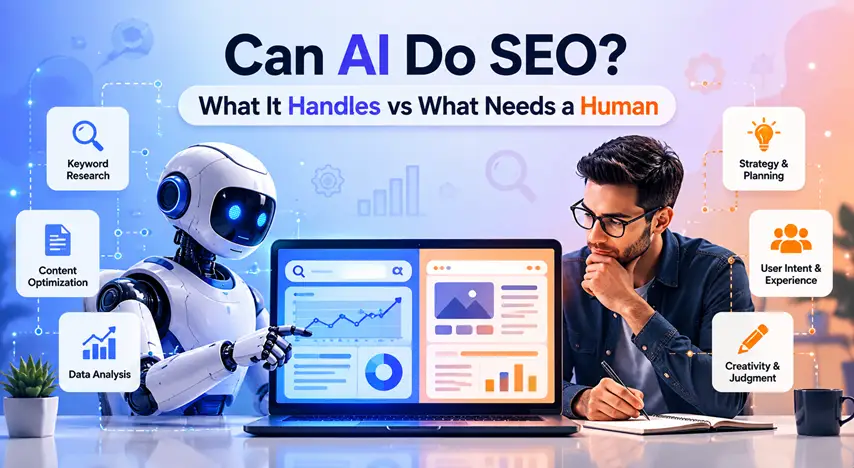
The tasks where AI genuinely outperforms manual work are the ones that are high-volume, pattern-dependent, and time-consuming without being strategically complex. In an SEO workflow, that covers more ground than most people expect.
Keyword research and gap analysis at scale
A human analyst working manually can review perhaps 200–300 keywords in a focused session. An AI system can process tens of thousands, cluster them by intent, map them against existing content, and identify gaps — in minutes. This is not a marginal improvement. It changes what is possible within a given budget and timeframe.
The caveat: AI can tell you which keywords exist and how competitive they are. It cannot tell you which ones matter for your specific business, your margin, your sales cycle, or your customer profile. That judgement still sits with a human who understands the business.
Content briefs and structure
AI can produce a well-structured content brief — the target keyword, secondary terms, suggested headings, questions to answer, approximate word count, and competitor content to reference — faster and more consistently than most content managers can manually. For agencies managing ten or more clients, the time saving here is significant.
The caveat: a brief is not a brief if it is built on a misunderstanding of search intent. AI tools frequently cluster keywords together that have subtly different intents. “Website maintenance cost” and “website maintenance pricing” feel similar — but one is asked by a business owner comparing providers, and one is asked by a developer scoping a client project. A human catches that. An unreviewed AI brief often doesn’t.
Technical SEO audits
Crawling a website, identifying broken links, flagging missing meta descriptions, spotting duplicate content, checking page speed scores, analysing Core Web Vitals data — all of this is mechanical work that AI handles well. Tools like Screaming Frog, Semrush, and Ahrefs have done this for years, and the AI layer now makes the analysis faster and the output easier to act on.
The caveat: a technical audit identifies issues. Prioritising which issues to fix first — and understanding which ones are genuinely affecting rankings versus which are cosmetic — requires someone who has seen these patterns across dozens of sites in different sectors and competitive landscapes.
Volume tasks at the content layer
Meta descriptions, title tags, schema markup, alt text for image libraries, FAQ sections, product descriptions at scale — these are tasks where AI reduces hours of manual work to minutes. For an e-commerce site with 800 product pages, AI-generated meta descriptions reviewed and approved by a human are significantly better than no meta descriptions at all, which is what most sites in that situation actually have.
🔍 Abhay Khurana — Reality Check
“We use AI for exactly these tasks internally — keyword clustering, technical audit summaries, schema generation, content briefs. It lets one SEO manager do the volume work of three. But every output goes through a human review before it reaches a client or goes live. The AI accelerates the mechanical layer. The judgement layer stays human.”
What Still Needs a Human
The tasks that AI handles poorly — or that it handles superficially well but dangerously wrong — are the ones that require judgement, context, and relationship. In SEO, those tasks are not peripheral. They are the strategy.
Understanding what actually matters for the business
AI can identify that “conveyancing solicitor London” has high search volume and commercial intent. It cannot tell you that your firm only handles cases in three London boroughs, that your best clients come from referrals rather than search, that your average case value means you only need 12 new enquiries a month to hit target, or that the keyword you should actually be ranking for is a lower-volume term that your competitors have ignored.
Business intelligence — the knowledge of where a company is, where it needs to go, and what search behaviour actually connects to commercial outcomes — is not in any training dataset. It is in the conversations, the accounts, the sales process, and the history of the business. That knowledge has to come from a human who has actually engaged with the client.
Knowing when something is good enough to publish
AI content tools will produce output that passes every mechanical check — correct keyword density, appropriate length, coherent structure, readable sentences. What they cannot reliably do is assess whether the content is genuinely useful, whether it reflects the business’s actual expertise, whether it says anything that competitors have not already said, or whether a reader would come away better informed than before they clicked.
The volume of AI-generated content that is technically SEO-optimised and substantively empty is already significant. Google is getting better at identifying it. The businesses that publish it are not building authority — they are building a liability.
Link building and digital PR
Acquiring links from genuinely relevant, authoritative websites requires outreach, relationship-building, editorial judgement, and often a news angle or original research that gives another publication a reason to cite you. AI can draft the outreach email. It cannot build the relationship that makes the editor read it. It cannot create the original study or proprietary data that makes the placement worth pursuing.
Adapting when the data does not tell a clear story
Rankings drop. Traffic dips. A page that was performing well suddenly stops. Sometimes the cause is clear — a Google algorithm update, a technical error, a competitor improving their content. Often, it is not clear at all. Reading ambiguous data, forming a hypothesis, testing it, and adjusting is not a mechanical process. It is the part of SEO that distinguishes a senior practitioner from someone following a checklist.
E-E-A-T — real experience, real expertise
Google’s E-E-A-T framework — Experience, Expertise, Authoritativeness, Trustworthiness — rewards content produced by people who have genuinely done the thing they are writing about. An AI system has no experience. It has patterns derived from what others have written. A plumber with twenty years in the trade writing about boiler installations in plain language will, increasingly, outrank AI-generated content on that topic — because the signals of genuine experience are legible to Google’s systems in ways that generated text is not.
Where AI and Human Work Best Together
The most effective SEO operations in 2026 are not AI-only or human-only — they are systems where AI handles the volume, speed, and mechanical consistency, and humans handle the strategy, quality control, and relationship layer.
🔍 Abhay Khurana — Reality Check
“The marketing director in Manchester did not have the wrong tools. She had the wrong model. The AI was unsupervised, producing volume without strategy, and nobody with SEO experience was reviewing what went live. The fix was not to remove the AI — it was to put a human back in charge of the judgement calls.”
Practically, this means:
– AI generates keyword clusters → a human decides which clusters align with business goals
– AI produces a content brief → a human reviews intent alignment and approves
– AI drafts content → a human edits for accuracy, tone, and genuine usefulness
– AI runs a technical audit → a human prioritises the fixes that will actually move rankings
– AI generates outreach copy → a human builds the relationship and adapts the pitch
This is exactly the model we operate at Logicsofts. If you want to see how it works in practice — for a business in your sector — our AI SEO service covers the full stack: content, technical, off-site authority, and LLM visibility monitoring.
The businesses getting the most out of AI SEO are the ones that have thought carefully about where human oversight sits in the process — not as a rubber stamp, but as a genuine quality gate.
If you want to understand where your current SEO operation sits — what is working, what is not, and whether AI could accelerate any of it — a free website audit is the most useful starting point. We will tell you honestly what the data shows, with no obligation to proceed.
FAQ
Can AI do SEO on its own without human involvement?
Not effectively. AI can automate specific mechanical tasks — keyword research, content generation, technical audits, schema markup — but it cannot set strategy, prioritise correctly, build relationships, or produce content that demonstrates genuine experience and expertise. Unsupervised AI SEO produces volume without quality, which increasingly harms rather than helps rankings.
Will AI replace SEO professionals?
No — but it is changing what SEO professionals spend their time on. Tasks that were previously manual and time-consuming (keyword clustering, briefing, technical audit summaries) are now faster with AI assistance. The work that remains irreplaceably human — strategy, judgement, relationship-building, genuine expertise — becomes more valuable, not less.
Does Google penalise AI-generated SEO content?
Google does not penalise content based on how it was produced. It penalises content that is thin, unhelpful, or manipulative — regardless of whether a human or an AI produced it. AI-generated content that is accurate, specific, and genuinely useful to the reader is not penalised. AI-generated content that is generic, hollow, or produced purely to fill keyword targets is treated the same way as low-quality human-written content.
What SEO tasks should I use AI for?
The strongest use cases are: keyword research and gap analysis at scale, content brief generation, meta descriptions and title tags across large page sets, technical audit data processing, schema markup generation, and first-draft content that a human then edits and enriches. In all cases, human review before publishing is essential.
What SEO tasks should I not hand to AI?
Strategy — which keywords actually align with your commercial goals. Judgement — whether content is good enough to publish. Link building and outreach — relationship-dependent. Reading ambiguous data and forming hypotheses. Any content that requires demonstrating genuine real-world experience in the topic.
How do I know if my current AI SEO approach is working?
Look at organic enquiry rate, not just traffic or rankings. If AI-assisted content is generating impressions but not clicks, your titles and meta descriptions may be misaligned with intent. If it is generating clicks but not enquiries, the content is not matching what the visitor actually needed. A technical audit of the pages in question will usually reveal the specific issue.
Is AI SEO right for small UK businesses?
It depends on volume and resource. For a small business producing one or two pieces of content per month with a focused SEO retainer, AI tools are a useful supplement — not a replacement. The efficiency gains of AI become significant when there is a large content gap to close, multiple service lines or locations, or a technical audit backlog that would take months to work through manually. If you’re unsure where you sit, our AI SEO service page explains exactly what’s included at each level and what the realistic starting points are.”
What is the difference between an AI SEO tool and an AI SEO agent?
An AI SEO tool (Surfer, Frase, Clearscope) is generic software that optimises against public benchmarks — it has no knowledge of your business. An AI SEO agent is a system specifically trained and configured on your business’s context — your services, differentiators, target clients, and competitive landscape. The distinction and how it affects output is covered in detail in What Is an AI SEO Agent?

Ready to Transform Your B2B Marketing Strategy?
Get a comprehensive SEO audit and discover how to drive more qualified leads to your business.
Get a Free SEO Audit