There is a marketing manager at a law firm in Leeds who spent six months paying for a well-known AI writing tool. Every week, she ran her content through it, followed its recommendations, and published what came out. The content was technically optimised. The keywords were in the right places. The scores were green.
Her rankings barely moved.
When I audited her site last year, the problem was obvious within twenty minutes. Every piece of content that her tool had helped produce could have been written for any law firm in the country. There was nothing in it that reflected her firm’s specific areas of focus, her team’s qualifications, the regions they actually served, or the types of clients they genuinely understood. The tool had optimised her content for a keyword. It had no idea what made her firm worth choosing.
That is the gap between an AI SEO tool and an AI SEO agent — and understanding it is increasingly important for any UK business making decisions about how to invest in search.
First: What Is an AI SEO Tool?
An AI SEO tool is software that uses artificial intelligence to help with specific SEO tasks. Most of them are well-known — Surfer SEO, Frase, Clearscope, MarketMuse, and NeuronWriter are among the more widely used. ChatGPT itself, used without configuration, falls into this category.
These tools are genuinely useful for particular jobs. They analyse the top-ranking pages for a keyword and tell you what topics, headings, and phrases those pages include. They score your content against those benchmarks. Some of them generate draft content at scale. They save time. They reduce certain types of manual research.
But they all work from the same starting point: the public web. They know what is already ranking. They do not know you.
Give a standard AI SEO tool your target keyword, and it will tell you to write about the same things your competitors are already writing about. That is, by definition, a path to producing content that is difficult to differentiate.
The tools are not failing at their job. They are doing exactly what they were built to do — optimise content against public benchmarks. The limitation is structural, not a fault.
What Is an AI SEO Agent?
An AI SEO agent — the kind we build as part of our AI SEO service — is a system configured and trained specifically for one business — that can plan, create, and optimise SEO work with an understanding of that business’s context.
The word “agent” is doing real work here. Unlike a tool, which responds to a prompt with no persistent memory, an agent is built to know things: who the business is, what they do, where they operate, what their differentiators are, how they talk to clients, what they have tried before, and what the competitive landscape looks like in their specific market.
The distinction I use when explaining this to clients is straightforward. An AI SEO tool is a skilled contractor you hire by the hour — they are competent, efficient, and available, but they show up knowing nothing about your business. An AI SEO agent is more like a senior team member who has been properly onboarded. They have read everything relevant about your business, your clients, and your market. They do not need to be briefed from scratch every time.
In practice, the difference shows up in the output. Ask a generic AI to write a page about conveyancing services in Reading, and it will produce something structurally competent and generically useless. Ask a trained agent that has been built with your firm’s specific practice areas, your named solicitors, your process, your fee structure, and your real client outcomes — and the output is completely different. It reflects the business, not just the keyword.
What Makes an AI SEO Agent Actually Work?
The quality of an AI SEO agent comes down almost entirely to the quality of the training data and configuration behind it. There are three things that separate a properly built agent from a chatbot with a system prompt.
Business intelligence documentation
Before any AI system can produce useful SEO content, it needs to understand the business at a level of specificity that most businesses have never put in writing. This means documented answers to questions like: What do you actually do differently from your competitors? What types of clients do you serve best — and which ones are actually a poor fit? What are the common objections you hear? What language do your best clients use when they describe the problem you solved?
This documentation — sometimes called a business intelligence document — is the foundation. Without it, you are configuring a system on top of a gap.
Contextualised training
Once the business intelligence exists, it needs to be embedded into the agent’s configuration in a structured way. This is not a one-time setup — it updates as the business evolves, as new content is published, as market conditions shift, and as Google’s signals change. The agent’s usefulness is directly proportional to how current and specific its knowledge is.
A defined scope of tasks
A well-built AI SEO agent is not a general assistant. It is configured to do specific things well: produce content briefs that reflect real search intent, draft page content that incorporates genuine business context, identify keyword gaps against competitors, and generate structured recommendations that a human can review and approve before anything is published.
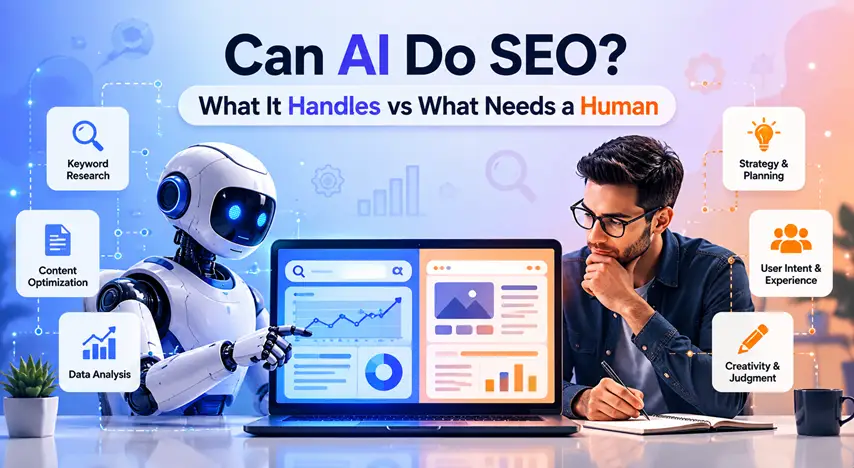
That last point matters. The agent handles the volume and consistency. The human — whether that is your in-house team or your SEO provider — handles the judgment, the strategy, and the final call on what goes live.
The Part That Most Explanations Skip
There is a tendency in discussions about AI SEO to frame this as a technology question. It is not, primarily. It is a knowledge question.
The technology — the large language models, the APIs, the platforms — is accessible. What is not accessible is the structured, specific, well-organised knowledge of your business that makes the technology useful. Most businesses have not documented this. Most SEO engagements have never asked for it. The strategy exists in someone’s head. The differentiators are implied rather than stated. The competitive context has never been mapped in writing.
An AI SEO agent does not create that knowledge — it applies it. Building the agent properly means doing the foundational work of understanding the business first, then configuring a system that can apply that understanding at scale.
This is why two businesses in the same sector, using nominally the same AI technology, can produce completely different results. The technology is not the differentiator. The quality of the business knowledge embedded in the system is.
Is an AI SEO Agent the Right Approach for Every Business?
No — and any honest answer has to say that clearly.
A properly built AI SEO agent represents a meaningful upfront investment in documentation, configuration, and testing. For a business producing one or two pieces of content per month, a standard SEO retainer with a skilled team is almost certainly the better use of budget. The compounding efficiency of an agent only starts to justify the build cost when there is volume — multiple content types, multiple locations, multiple service lines, or an ongoing need for structured SEO output that a manual process cannot sustain.
The businesses that benefit most from this approach tend to share a few characteristics. They have a content gap that is too large to close manually within a reasonable timeframe. They have the business knowledge to train a system properly. They want to own the infrastructure rather than remain dependent on a service they do not control. And they have someone — internally or externally — with the judgement to review and approve what the system produces.
For businesses at an earlier stage, or those whose SEO needs are well-served by a focused monthly retainer, standard SEO services remain the most direct path to results. If you want to explore what AI SEO looks like as a managed service — built around your business specifically — our AI SEO service covers the full picture.
If you are not sure which category your business falls into, the most useful starting point is an honest audit of where you are now — what is working, what is not, and what the gap actually is. A free website audit will tell you that in plain terms, with no obligation to proceed.
FAQ
What is the difference between an AI SEO tool and an AI SEO agent?
An AI SEO tool is generic software — it analyses public search data and optimises content against what is already ranking. An AI SEO agent is a system trained specifically on one business’s context, knowledge, and market. The tool knows the keyword. The agent knows your business.
Can an AI SEO agent replace my SEO team or agency?
No — and it should not try to. An AI SEO agent handles the volume, speed, and consistency of output. Human expertise is still required for strategy, judgement, quality review, and the relationship-driven elements of SEO, such as link building and PR outreach. The agent works best when paired with human oversight, not in place of it.
How is an AI SEO agent different from using ChatGPT for SEO?
ChatGPT, in its default state, has no knowledge of your business, your clients, your competitors, or your market. It produces content based on general training data. An AI SEO agent is specifically configured and trained on your business intelligence, which means the output reflects your actual context — not a generic approximation of your sector.
What does it cost to build an AI SEO agent for a UK business?
The cost varies significantly depending on the complexity of the business, the scope of the agent’s tasks, and the volume of content or SEO work it needs to produce. It is a meaningful upfront investment — typically positioned as a build fee followed by an ongoing management or licensing arrangement. It is not the right approach for every business at every stage.
What is a business intelligence document, and why does it matter for AI SEO?
A business intelligence document is a structured record of everything a well-trained SEO team member would need to know about your business — your services, differentiators, target clients, common objections, preferred language, and competitive context. It is the foundation that makes an AI SEO agent produce specific, relevant output rather than generic content. Without it, the agent is operating on guesswork.
How long does it take to build and deploy an AI SEO agent?
A properly built system — including business intelligence documentation, configuration, testing, and initial content output — typically takes four to eight weeks from first brief to working deployment. Rushing this process produces a system that performs generically rather than specifically.
Are AI SEO agents used by UK businesses yet?
Adoption is early. Most UK businesses are still using generic AI writing tools or standard SEO retainers. The businesses investing in bespoke AI SEO infrastructure right now are predominantly those with significant content requirements, multiple service lines or locations, or a strategic interest in owning their SEO capability rather than renting it.
Will Google penalise content produced by an AI SEO agent?
Google’s position is consistent: it evaluates content on the basis of quality, usefulness, and originality — not on the basis of how it was produced. AI-generated content that is generic, thin, or designed to manipulate rankings is treated the same way as human-written content with the same characteristics. AI-generated content that is specific, accurate, and genuinely useful to the reader is not penalised. The determining factor is quality, not origin.

Ready to Transform Your B2B Marketing Strategy?
Get a comprehensive SEO audit and discover how to drive more qualified leads to your business.
Get a Free SEO Audit