According to a book called Attention Span by psychologist Dr. Gloria Mark, the attention spans of people have been shrinking over the past two decades. It was 2.5 minutes in 2004.
It decreased to 8.25 seconds in 2023 and in 2024, it’s merely 8 seconds.
While social media platforms are embedding short videos for the same reason, writing is supposed to be concise, too. Right? Well, the answer is yes.
Concise writing is crafting a piece of text according to the current psychology of the readers.
It is something that combines both art and science in one spot. It focuses on selectively using only valuable ideas, words, and phrases.
Now that you know the basics, let’s explore today’s topic in detail. Learn what concise writing is in detail, along with all the tips and tricks to achieve this goal.
What Exactly Is Concise Writing?
Concise writing conveys the message you want to convey effectively using the minimum number of words. Doing so keeps the length of the content short since there are no fluff phrases, redundancies, or unnecessary words.
While one aspect of concise writing is reducing the text length, it is way more than that. It is a way to improve the readability of the text and save the readers’ time. Readers can better focus on only what is necessary; with nothing spare.
Tips and Strategies to Make Writing Concise
Use Active Voice
Active voice is considered the best pick over passive voice for good writing. The reason is that the active voice is concise, clearer, and more interesting. You can strongly directly convey your message.
The thing that makes active voice clearer is the sentence structure. It clearly depicts who is doing the action; the doer comes first, followed by the verb and receiver. For example:
“The bobcat humiliated the grizzly”
is in active voice.
However, use passive voice if you want to convert a harsh message softly or if the doer within the sentence is unknown. For example:
“Cynthia’s home was robbed last month“
is in passive voice as the robber isn’t identified yet.
If there isn’t any special case to prefer passive voice, active voice should be used in all the writings. Again, we want to keep the writing concise which is easy to achieve if we use active voice sentence structure.
Avoid Redundant Words
In linguistics, a redundancy is mentioning the same information more than once in content. Meaning:
redundancy = unnecessary repetition.
Doing this makes your message wordy, longer, and less clear without adding any value. It also slows down the readers which is something they don’t like. So, remove repetitive words to simplify sentences and convey our message faster.
For example, if there is a sentence like “I believe the zoo has several varied species”, make it “The zoo has several species” by removing repetition.
Here are some other examples of redundancies and how we can remove them:
- Advance warning → warning
- Whispered quietly → whispered
- Utilise → use
- Adequate enough → Adequate
- Merge together → Merge
- Past experience → Experience
- The reason why → Why
- Sit down → Sit
Use Stronger Adjectives
Adjectives are used to describe or modify nouns or pronouns. They can also be used to express the qualities of something or someone in a piece of text. For example, in “This house is beautiful”, the term “beautiful” is an adjective.
However, sometimes, certain intensifiers are used alongside the adjective to make it more descriptive. For example, terms like very, really, extremely, incredibly, particularly, exceptionally, etc. The only downside of this is that these make the writing lengthier.
So, instead of using the ‘intensifier + adjective’ combination, choose a stronger adjective. For example, instead of saying “The music in the club was very loud,” you could say “The music in the club was deafening“.
Here are some other examples:
- Extremely happy → overjoyed
- Very big → enormous
- Very clever → Brilliant
- Walked very fast → hurried
Cut Down Unnecessary Phrases
The English language uses a lot of idiomatic phrases. Although these don’t contribute to the meaning significantly, they make sentences longer. Find these phrases in your content and use short alternatives to them. For example,
- Due to the fact that → because
- In order to → to
- There is a chance that → could, may, might
- This is why → because, since, why
- This is an example of → this is
- There is a need/necessity for → must, should
When crafting a writing piece, remove such unnecessary phrases from the content. Use their to-the-point alternative to reduce the word count, make the writing concise, and improve the overall readability and clarity.
Go for Short Sentence Structure
Writing long sentences not only confuses you but also the reader, which is something we don’t want in concise writing. Therefore, when crafting such a writing piece, opt for short sentences as these are one of the most important aspects.
Once you’re done with the writing, read it aloud. Use specific examples, words, and phrases. Break down complex sentences into shorter ones. Ensure every sentence is digestible for your audience and supports the topic sentence.
Remove Conjunctions
When creating shorter sentences, one way to do so is to look for the conjunctions. These are parts of speech used to connect or coordinate words, clauses, or sentences. The following are commonly used lists of conjunctions:
- In order to
- And
- Or
- So
- Since
- For
- Because
- As
- But
- Yet
- Still
- While
- As soon as
- Therefore
- Moreover
- In case
- Though
- Although
- Even though
- If
- Unless
Wherever conjunctions are used, there are chances to break the sentence. All you have to do is to find the point where a conjunction is used and find a way to split longer sentences into two short pieces from there.
Best Way to Make Your Writing Concise
If you follow all the tips and tricks we discussed earlier, you can make your writing concise and effective. However, this is a manual procedure. And manually concise down a writing piece takes a lot of time and effort.
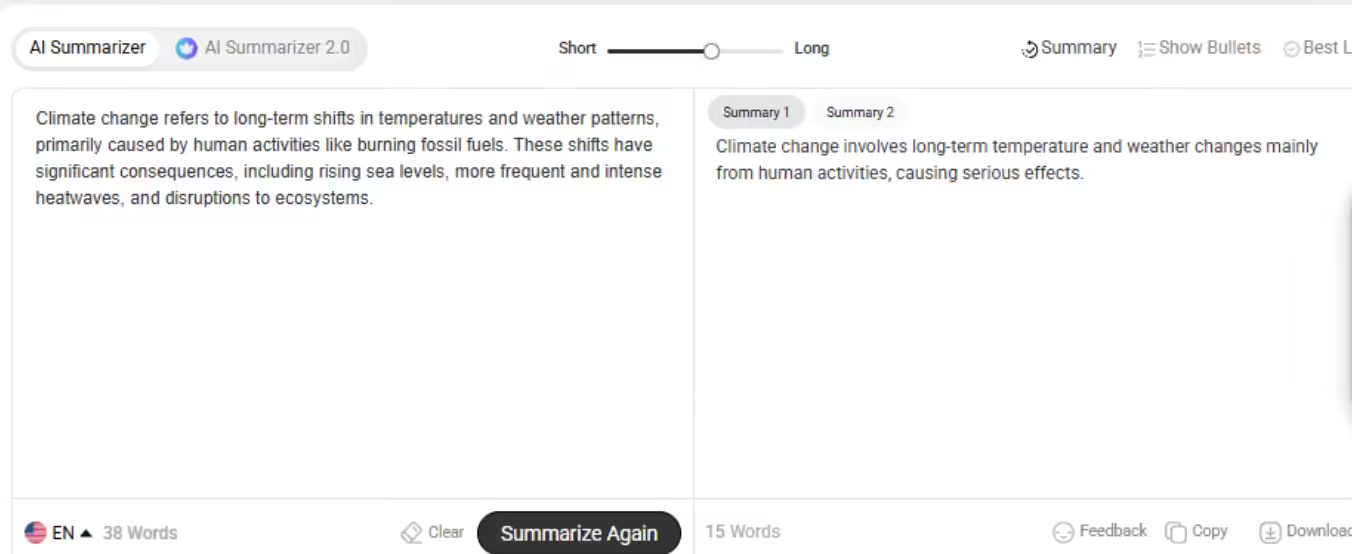
Alternatively, you can use the AI Summarizer. This tool uses advanced AI and NLP algorithms to read and understand submitted text. It pinpoints the important sentences, terms, and information. It rewrites and combines it concisely.
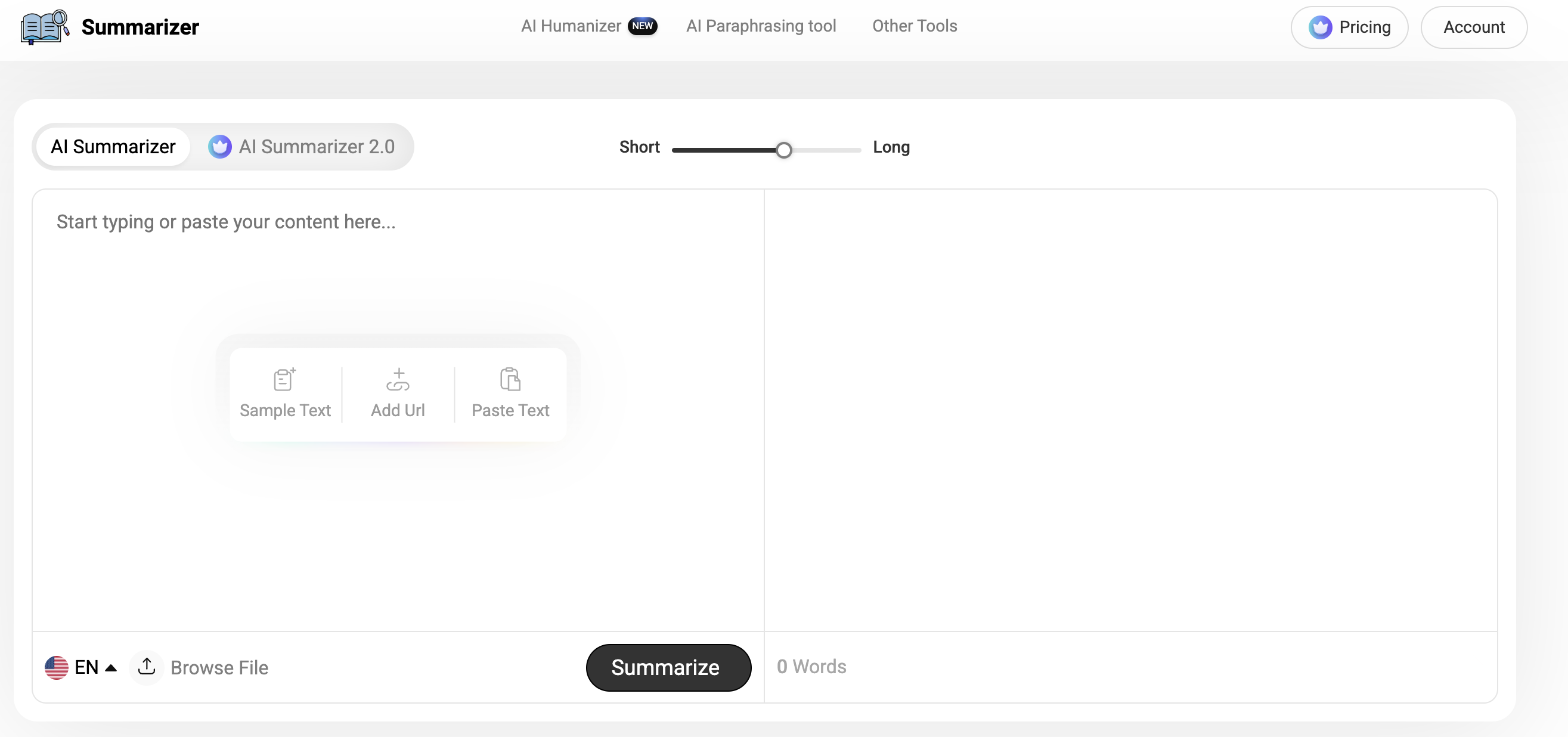
All you need to do is paste your writing piece in the text input box. Select the summarization mode and choose the length from the slider. Click on the Summarize button and wait for a while to get a summarised text.
This is how these tools make writing concise:
Conclusion
Concise writing is all about using fewer words to convey your message or idea comprehensively. The first thing you should do is to write in an active voice, where the doer of the action comes first in a sentence.
Avoid redundant words and phrases to get rid of unnecessary repetitions. Choose stronger adjectives instead of using weak ones with intensifiers.
Cut down on idiomatic phrases and use shorter alternatives. Opt for short sentence structures and remove conjunctions where possible. Read aloud, break complex sentences into shorter ones, and use summarising tools.

Ready to Transform Your B2B Marketing Strategy?
Get a comprehensive SEO audit and discover how to drive more qualified leads to your business.
Get a Free SEO Audit