Today, it’s quite difficult to guide a user from the first contact to a purchase. That’s exactly why the marketing theory of 7 touches exists, on average, a user needs to see a product or service 7 times before making a final purchase decision. A person might first see a printed ad, then “Google” the product, read reviews, check opening hours, and only then make a purchase. This is where local listings management plays a key role.
Usually, when planning a marketing strategy, the focus shifts to social media or targeted advertising, but local listings can become a crucial component, whether it’s Google Maps, Yelp, Facebook, or Apple Maps.
If the information there is incorrect, you can quickly lose a user. For example, if someone planned to visit your store because Google Maps shows it’s open, but in reality, it’s closed = you’ve just lost a customer.
Why is Local Listings Management so important?
Besides the obvious convenience for users, it helps you rank better in search engines. Google will boost your SEO and position in search results if you have a well-filled Google My Business profile. And that’s the main goal, to appear in results for searches like “coffee shop near me”, “coffee shop in Delaware”, and so on.
In addition, consistent information, such as address, phone number, and other details, builds user trust and loyalty.
In other words: online listings = offline actions.
Think with Google states that 76% of people search for “near me” queries, and 28% of them lead to a purchase. Even the presence of a “search by distance” filter is direct proof of how important this is to users.
That’s why reviews, photos, accurate business hours, and contact info are your foundation for interacting with users. And well-optimized profiles = higher conversions.
How exactly does Local Listings Management increase conversion?
The marketing funnel includes several standard stages: awareness, consideration, conversion. If we translate that into listings: a user visits your Google My Business, compares photos and reviews with your competitors, and it ends in a call, website visit, or purchase.
Sometimes, the website visit doesn’t even happen, the person makes a decision based solely on local listings. Especially now, since these platforms are so advanced, that booking, calling, or messaging can be done directly.
Why can’t this be done manually?
Updating listings manually is possible if you only have a few locations. But if you own a franchise with 50+ locations, avoiding critical errors becomes incredibly hard. It’s a huge time investment, one that could easily be replaced with automation.
A single mistake can even lead to a negative review: “I came based on the opening hours shown on Apple Maps, but it was closed. I spent 1.5 hours on the road, a complete waste of time. I’m never coming back.”
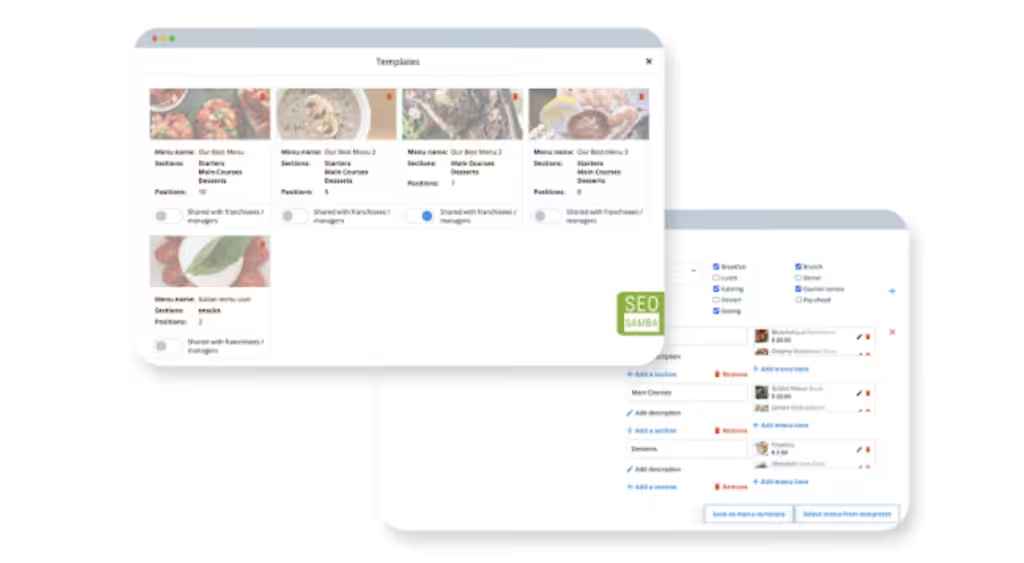
To avoid this, there are services like SeoSamba’s local listings management, which let you manage multiple locations from one platform.
More than 100+ platforms can be updated at once and synchronized in just a few minutes. In addition, you can promote SEO, manage reviews, and automate marketing processes like blogs, email campaigns, and more.
The market is now incredibly competitive, and users have hundreds of options to choose from. So even the smallest detail can affect conversions. Well-optimized, synchronized business processes help you smoothly and quickly guide your target audience through the marketing funnel, helping you achieve your KPIs, while the user gets what they’re looking for.

Ready to Transform Your B2B Marketing Strategy?
Get a comprehensive SEO audit and discover how to drive more qualified leads to your business.
Get a Free SEO Audit