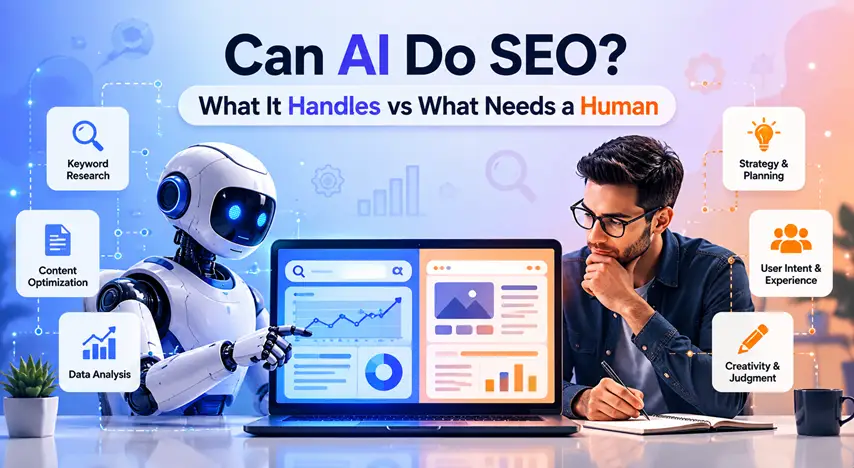
Traditionally, if you wanted your content and products to be found, you would invest in search engine optimisation. That’s because Google search was the primary way of finding information online.
Now, Google is slowly losing that position and giving way to the growing popularity of LLM search. This calls for a new approach to online search visibility, one that addresses the new ways people find information online.
How have search trends changed, and what should business owners expect next? This article will explore both of these questions and provide tips on how to combine AI and SEO to increase brand awareness in search.
The Fractured State of Search
Firstly, let’s take a look at how global trends in information search have changed.
Current State of Search
As of today, the largest change in the search trends is that users are slowly going away from only using Google and starting to use other platforms for search. Here are the main findings.
- Google remains the leading way people search for information, but it’s not a monopolist as it used to be. Currently, it is responsible for 81% of digital queries.
- People use other media to find information or discover brands, such as social media, Reddit, or YouTube.
- LLMs like ChatGPT, Gemini, and Perplexity have recently started being used for informational searches, with ChatGPT handling 9% of queries.
- Google itself is implementing AI heavily, introducing AI Mode, which works similarly to other LLMs in terms of informational searches.
- AI Overviews are now taking up the space on top of search results, bringing the organic results down. The information provided in AIO means that more people can resolve their search without clicking on any of the links in SERP—only around 40% of searches end in a click.
- Search optimisation is moving from keywords to topics and prompts. Content should be centred around answering several questions rather than simply including several keywords in the text.
How Can Сompanies Deal with the Changes
Despite Google still leading the informational search landscape, the surge in usage of other avenues of search cannot be left without a strategic response. Here are the three most important solutions to implement for AI SEO.
- Diversify your brand’s digital presence. Since there’s more variety when it comes to discovering information, you can’t invest in a single medium. You need to build brand presence across multiple platforms and optimize for different ways people find information.
- Choose platforms strategically. Base the choice of the marketing platforms you invest in on your target audience. Research how your ideal customers discover brands before settling on the decision.
- Create relevant content. Content relevance is even more important with LLMs being a part of the search landscape. Structure your content to be relevant to the search intent behind the keyword or prompt you focus the article on.
Tracking Brand Performance in AI Search
There are dozens of tools for tracking and analyzing performance metrics in traditional SEO and on most social media platforms. AI search, being a newer addition to the channels you need to worry about, has fewer options.
Since LLM search is a new medium and doesn’t have as many established best practices, it’s important to have a way to track your brand’s visibility on it. Use one of the recently developed tracking tools, like the AI visibility tool by SE Ranking.
This SEO and GEO tool can help you understand how your brand appears in LLM search, what types of queries it shows up for, and what the context is in the answer. It allows you to filter the visibility analysis to a niche or a topic for a deeper understanding of LLM performance, and view historical data for prompts to track changes in your brand’s visibility.
Apart from tracking visibility, you might need to change your approach to calculating effectiveness from traditional attribution models to the long-term influence of brand visibility on a cluster of topics in the LLM.
Influencing LLMs and GEO
Since LLMs have become a major part of how people search for information, only doing traditional search optimization is not an option anymore. Businesses that want to be visible to all types of audiences, regardless of their search preferences, need to combine AI and SEO strategies.
This discipline is in its inception, so a few different terms have appeared to describe it. One of the most used ones is GEO (Generative Engine Optimization), which tries to mimic the term SEO. It’s also being called AIEO or AEO, AI engine optimization, in a similar fashion, as well as AI SEO. You might find it being referred to by AI visibility optimization, or AIVO.
Whatever term is used, it refers to a loose set of practices aimed at maximizing your brand’s appearances in AI search queries. The efforts are mostly aimed at influencing Google AI Overviews and AI mode, as well as the most popular LLMs like ChatGPT, Perplexity, Gemini, or Claude.
Thanks to both Google’s AI search experiences and LLMs being reliant on Google’s index for information, a lot of techniques are closely related to SEO, but not identical to it. Here are the most important areas of GEO established so far.
Strong Online Presence
Building an online presence is important for AI visibility. Apart from referencing and linking to training data in the search results, LLMs use search engines to retrieve information. They can break down user prompts into several search queries, reference the websites found on the search engine, provide information from them in the response, and link to them.
That’s why doing traditional SEO link building to rank well also translates into AI optimization. Websites from Google’s top ten for a keyword also often appear in the AI Overview sources.
Even though ChatGPT uses its vast database to find information and can rely on Google as a fallback, it currently uses Bing as the primary search engine. You might want to do a bit of optimization for that search engine if you want to improve visibility on ChatGPT. The most important steps are getting a Bing Places Profile for your local business and making sure the sitemap is visible to Bing crawlers.
Shift from Rankings to Mentions in AI and SEO
Building backlinks to improve your rankings for particular keywords on Google isn’t the only way online presence can influence your AI SEO. Mentions on third-party sites, even without a link, can be shown on search results.
Earning those mentions means more visibility on LLM search.
Earned, Owned, and Rented Media
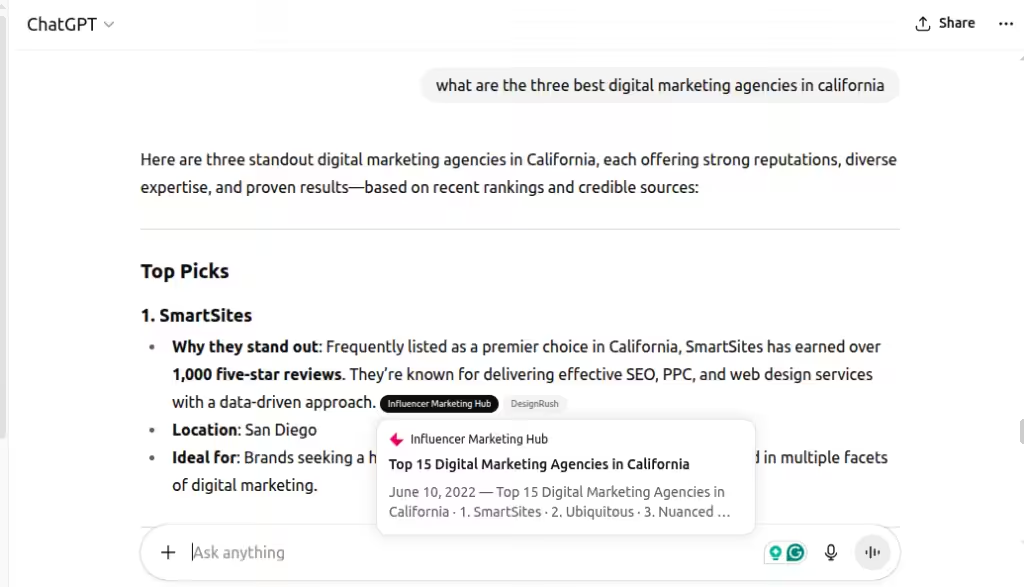
Earned media are editorial mentions of your brand on other websites. They can be beneficial for both SEO and AI for SaaS companies and other B2B businesses. For instance, a lot of searches for best-in-class businesses are referenced from listicles published on reputable sites like this one.
Source: ChatGPT
Alt: A mention in a listicle is referenced on ChatGPT.
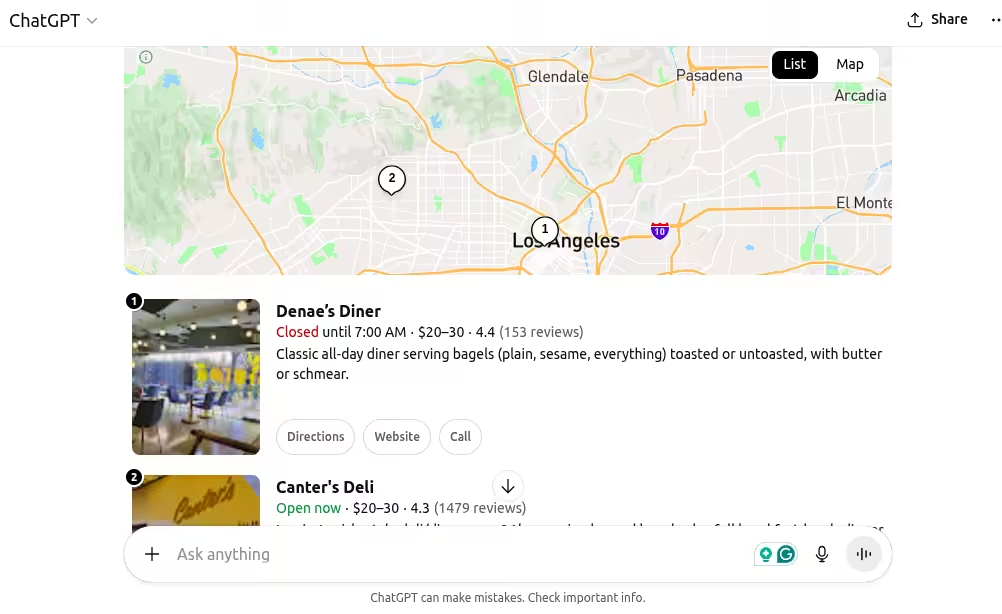
Owned media like a Google Business Profile or Bing Places for business can also show up in AI searches on Google’s AI Mode and ChatGPT.
Optimize your profiles by acquiring reviews and providing correct business details to increase the odds of them appearing in AI search.
Rented media assets, those posted on content hosting sites like social media or YouTube, can also make it to AI search. YouTube, in particular, is well-integrated in LLM results.
Most LLMs won’t reference videos unless the prompt calls for it. AI Mode on Google will feature videos at the end of the response for some queries.
All three types of media are important for gaining more visibility in AI search.
Crawlable and Indexable Content
Content on your site should be crawlable and indexable to have a chance of getting mentioned in AI search. Your robots.txt file should allow crawling for AI agents, important pages should have structured data, and the website structure should facilitate crawling.
For easier crawling of content on each page, make it revolve around posing and answering potential user questions. Adding an FAQ section or using questions from existing FAQs to create new articles are good ideas.
How to Optimize Content for AI SEO
Ranking well on Google and Bing and getting mentions on third-party sites are key to getting your brand mentioned on LLMs. Getting your content mentioned requires a bit of optimization. Here are the most notable tactics.
Prioritizing E-E-A-T
Google’s E-E-A-T metric, which refers to experience, expertise, authoritativeness, and trustworthiness of a text, can also help your content in AI search. The major avenues for improving this metric are getting the author mentioned on third-party websites and increasing accuracy and practical expertise in the text.
The former can bring in LLM mentions from other websites. The latter can improve the odds of your content showing up in LLM search.
Structured and AI-Friendly Content
On top of the high quality of the content, it needs to be structured in a way that’s easy for AI to parse. One aspect of it is using schema markup to provide more information about each page. You can use AI and machine learning in SEO to figure out what pages need structured data and generate Schema markup for them.
AI is quite good at analyzing written text, so you should only include a few elements that are easier to include as an answer to a search query.
- Having clearly labeled headings helps AI find the information on the page.
- Writing short, concise paragraphs helps parsing.
- Framing the text as a series of questions and answers can be easier for AI to quote.
- Numbered lists are great because they are often included in replies.
- FAQs at the end of an article can be making a comeback as they have the question-and-answer dynamic useful for AI answers.
Original Insights and Proprietary Data
The odds are, most well-known facts will be quoted by AI from sources that have been established a long time ago. Your best odds of getting your content featured in an LLM response are writing about original insights and findings.
One way to do it is to conduct proprietary research and write about the data. But that requires a significant investment. The easier option is to look at old problems from a new perspective and suggest nonorthodox solutions. If a solution wasn’t talked about much before, it has greater chances of being sourced by an AI search.
The Rise of Alternative Intents
In traditional search, search intents can be of four types:
- Navigational to find a specific page or a website.
- Informational to find information.
- Commercial to compare products or services.
- Transactional to make a purchase.
AI instruments add two other types of intent. Generative intent is aimed at having the LLM generate something, be it a text, code, or something else. These types of queries may push traditional informational searches to the side. There’s no need to ask an AI to explain how to write something in Python if it can do it for you.
There’s no going around this, and visibility for these queries is unlikely.
Another type is agentic intent. In this one, the user asks the AI to perform an action like booking tickets or buying something. Here, investing in visibility on Google search can lead to direct sales through LLMs.
Adaptability, Continuous Learning, and Ruthless Action
With AI search becoming more popular, especially among the younger generation, businesses need to adapt or become invisible. Here is what you should focus on.
-
- Embrace the change. The changes in the search patterns of global populations are only going to progress towards AI until a new equilibrium is found. The only thing you can do is learn and adapt.
- Learn how AI search works. Observe what content is shown in AI searches and experiment with content formatting to see what works.
- Avoid sunk costs. Stop investing in channels that don’t produce traffic. For instance, if ranking for a keyword produces impressions but not clicks, it’s safe to assume you can stop optimizing for it.
- Invest in alternative traffic channels. Generational intent can eat into click-through rate on LLMs. Invest in other channels to make sure you have visibility around the web.
- Look out for further changes. The future of SEO and AI is not set in stone. You have to be informed about where the industry is going to anticipate a necessary change in strategy.
Summary
SEO is not obsolete, but GEO is going to become an important part of digital marketing. SEO and AI optimization can work hand in hand. Work on improving SEO, and a lot of the efforts will translate into AI visibility optimization. Increase your brand’s mentions on third-party authoritative platforms and work on improving content originality to get listed in AI sources.
BIO
Vanessa Friedman is a content marketing professional who helps companies attract visitors, convert leads, and close customers. Previously, Vanessa worked as a marketing manager for a tech software startup company.

Ready to Transform Your B2B Marketing Strategy?
Get a comprehensive SEO audit and discover how to drive more qualified leads to your business.
Get a Free SEO Audit