Social media’s louder than ever in 2026.
There’s more content, more platforms, more noise — and yeah, more pressure to “prove” that what you’re posting is actually working.
But here’s the kicker: more data doesn’t equal more clarity.
You can stare at charts until your eyes glaze over and still have no clue what to post next. Analytics are supposed to help. Yet too often, they just stress us out.
So, let’s talk about what really matters now — not just tracking numbers, but understanding them.
Not just gathering data, but actually using it to make smarter, faster decisions.
The Difference Between “Reporting” and “Understanding”
Here’s a scenario: your engagement is down 15%.
A basic report might say, “Engagement dropped.” Not helpful. Understanding would go further — “engagement dropped because we changed our posting time, and the new format isn’t landing with our Gen Z audience.”
That’s the difference.
Reporting gives you the “what.”
Understanding gives you the “why” — and more importantly, the “what next.”
One’s passive. The other?
It’s the compass you need when the content landscape starts shifting (which it always does).
What Defines Effective Social Media Analytics in 2026?
We’re in an era where strategy must be agile. Data isn’t about wrapping things up in a bow — it’s about guiding the next move, spotting trends while they’re still forming, and adjusting before the campaign’s halfway over.
Here are five components shaping the most effective social media analytics strategies this year.
1. Goal-Aligned Metrics (Not Just Pretty Numbers)
Vanity metrics can feel good — likes, shares, follower counts — but they’re not always tied to real business outcomes.
Effective analytics means tracking metrics that ladder up to actual goals.
If your goal is conversions, but you’re obsessing over reach… you’re solving the wrong problem.
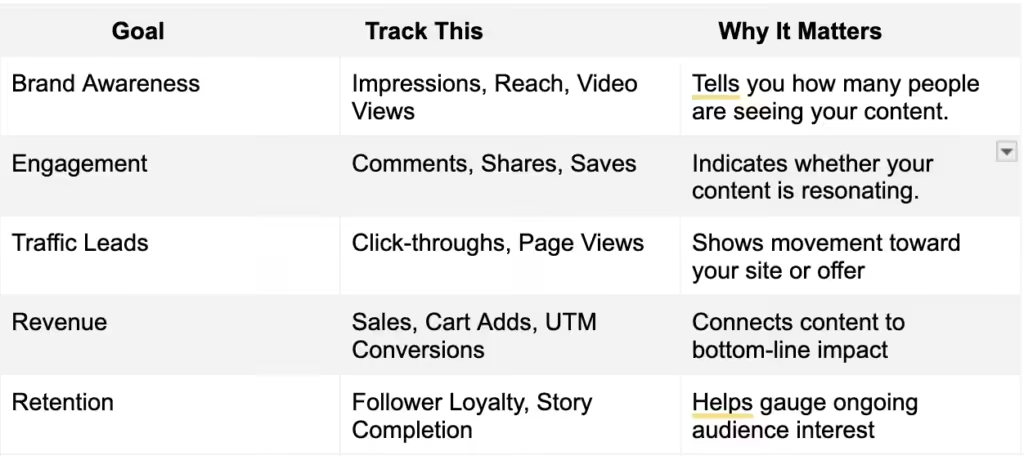
If your metrics don’t relate to your north star? You’re probably wasting time.
2. Location-Specific and Multi-Brand Insights
Let’s say you’re managing multiple restaurant brands.
One audience responds to behind-the-scenes prep shots, another wants promo codes, and a third just wants moody interiors and cocktails. You can’t evaluate them all with the same lens.
That’s why platforms like Sked Social’s restaurant social media content calendar are invaluable.
They let you manage multiple accounts, view localized insights, and compare performance — without treating every brand or location like a copy/paste template.
The truth? What wins in Miami may tank in Seattle. Sked helps you adapt accordingly, with real-time visibility across all your accounts.
3. Timely, In-Flight Analysis
By the time you finish a monthly report, half your audience has already moved on. Trends expire fast, and attention spans? Even faster.
In 2025, analytics must be actionable at the moment.
That means checking performance while campaigns are still live — tweaking captions, adjusting budgets, or even pulling posts that aren’t landing.
You don’t need perfect data. Just fast enough to steer.
Some teams even run A/B testing on post formats or CTAs in the same week. It’s not about overreacting to every dip — it’s about staying light on your feet.
4. Insights with Human Context
Numbers don’t always tell the full story.
A post might underperform on engagement but spark ten DMs with serious sales potential. Or a quiet carousel might later get referenced in a customer review.
Effective analytics? They leave room for those gray areas.
You’ve got to pair quantitative data with qualitative feedback — comments, team insights, even gut instinct. That’s the stuff that can’t always be graphed but often holds the real answer.
5. Predictive, Not Just Reflective
The best tools now offer predictive analytics — giving you a sense of what might work before you even hit publish.
Think AI-generated posting recommendations, best-time-to-publish insights, and forecasted engagement curves. No, it’s not crystal ball magic. It’s just pattern recognition done at scale.
These predictive tools don’t replace your team’s judgment — they support it. Especially when time’s tight and pressure’s high.
Conclusion
In 2025, effective social media analytics isn’t about showing off a slick dashboard or dropping numbers into a monthly report. It’s about clarity.
It’s about knowing — confidently — what’s working, what’s not, and where to go next.
The best brands are no longer guessing.
They’re tracking the right things, at the right time, and using tools that help them see the whole picture — not just a slice of it.
So the next time someone says, “Let’s check the analytics,” don’t just look back. Look forward. That’s where the real value is.
Featured Image Credit: Pexels

Ready to Transform Your B2B Marketing Strategy?
Get a comprehensive SEO audit and discover how to drive more qualified leads to your business.
Get a Free SEO Audit