Direct-to-consumer (DTC) used to mean one big advantage: you owned the channel. In 2026, it means you also own the complexity such as performance, measurement, content quality, product discovery, and a store experience that has to convert on mobile, at speed, across regions.
The market is still expanding.
Ecommerce is expected to represent ~20.5% of worldwide retail sales in 2025, with continued growth projected beyond that. But “being online” isn’t the hard part anymore. Winning organic visibility is.
That’s where many DTC brands hit a wall: they apply a generic “SEO template” to a Shopify store and wonder why results plateau.
Shopify SEO looks similar on the surface (keywords, content, links). Under the hood, it’s a very specific environment with platform constraints, duplicate URL patterns, JavaScript/performance trade-offs, and ecommerce-specific intent signals.
Shopify even operates at a massive scale; its 2025 GMV was $378,441M (US$378.4B), with 29% GMV growth highlighted in its Q4 2025 results.
For DTC, that scale translates to competition, not comfort.
Why “template SEO” fails on Shopify
Shopify creates SEO problems that don’t exist on brochure sites
Shopify stores aren’t “a set of pages.” They’re dynamic catalogs with:
- Collections (category pages) that can be filtered/sorted
- Products appearing in multiple collections
- Variant URLs and parameter URLs
- Pagination and faceted navigation
If this isn’t controlled, you get duplicate content, split authority, and crawl budget waste, especially painful as catalogs grow.
Many Shopify themes handle some canonicals, but they don’t solve strategy-level issues like which collection should rank for what, how filters should behave, and what should be indexable vs. not.
Google’s quality bar keeps rising, and ecommerce feels it first
Google explicitly positioned the March 2024 Core Update as a quality-focused evolution, improving how it identifies “helpful” content and pairing it with stricter spam policies (including “scaled content abuse”).
For DTC, this matters because ecommerce sites are full of templated patterns by nature: thin category copy, near-duplicate product descriptions, AI-generated “SEO text,” and mass-produced blog content. A specialized approach focuses on:
- commercial intent coverage (category + product + comparison content)
- differentiated information gain (what you add beyond manufacturer copy)
- trust signals (policies, reviews, expertise, provenance, proof)
Speed and UX are not optional, and Shopify stores can get heavy fast
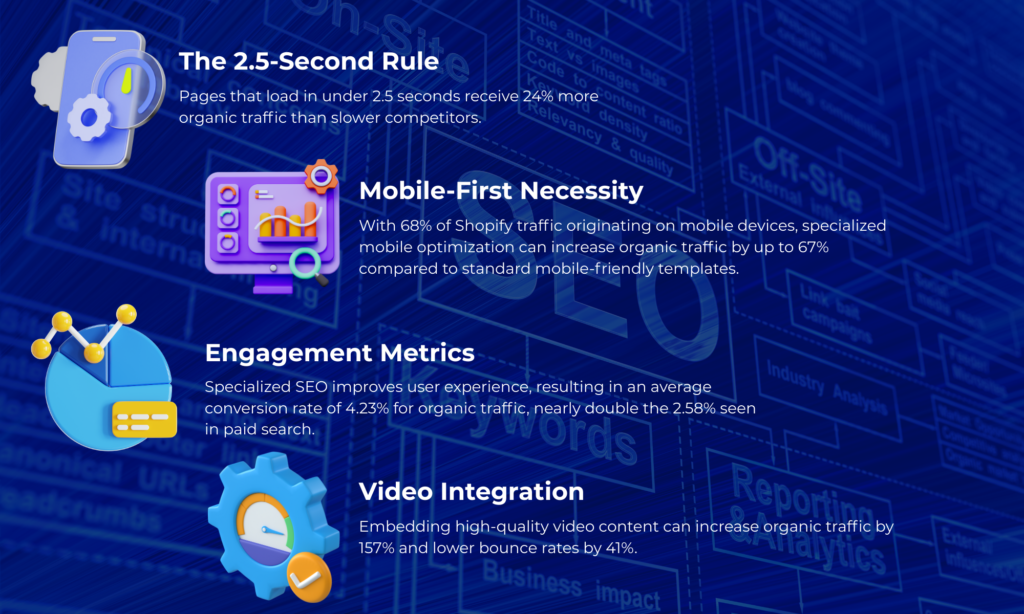
Core Web Vitals remain a practical battleground. INP (Interaction to Next Paint) replaced FID as a Core Web Vital in March 2024, raising the importance of real responsiveness; not just load time.
Shopify’s app ecosystem is powerful, but it’s also a common source of:
- extra scripts
- render-blocking assets
- tag inflation (pixels + tracking + widgets)
- slow collection pages (filters, quick-add, infinite scroll)
Template SEO rarely includes technical triage, app/script governance, or UX performance work; yet those can directly affect both rankings and conversion.
What specialized Shopify SEO looks like (and why DTC needs it)
DTC teams also tend to outgrow “generalist SEO” faster because Shopify isn’t just a CMS—it’s a catalog engine with collection logic, variant complexity, faceted navigation, and app-driven performance trade-offs.
A specialist approach typically combines collection-led keyword mapping, indexation control (canonical + parameter handling), internal linking that prioritizes revenue pages, and Core Web Vitals improvements that protect both rankings and conversion rates.
That’s why many scaling brands specifically look for specialized Shopify SEO services for DTC brands, not as a “nice-to-have,” but as a way to align technical SEO, merchandising structure, and on-site UX so organic traffic actually converts.
Below is the difference between “doing SEO on Shopify” and “doing Shopify SEO.”
Collection-led strategy (because category pages are the revenue lever)
For ecommerce, category/collection pages often drive the most scalable, intent-rich traffic. A specialized Shopify SEO approach typically includes:
- keyword-to-collection mapping (one primary intent per collection)
- collection architecture that mirrors how people shop (not how inventory is stored)
- internal linking models that push authority to money pages (not just blogs)
- copy that helps users choose (materials, fit, use-cases, comparisons, FAQs)
A useful benchmark for context: average storewide ecommerce conversion rates globally are often around ~1.58% (with big variation by device and vertical). If your SEO is bringing top-of-funnel traffic that doesn’t match product intent, you’re not just missing rankings—you’re importing low-converting sessions.
Duplicate URL and crawl control (the Shopify-specific technical layer)
Specialized Shopify SEO puts guardrails around:
- faceted navigation: deciding which filters create indexable pages (if any)
- parameter URLs: controlling sort/filter/tracking parameters
- canonical consistency: ensuring the “rankable” version is stable
- pagination: preventing index bloat while keeping discovery strong
- product-in-multiple-collections: preventing duplicate product URLs competing
This is where platform experience matters: Shopify has common URL structures and behaviors that an ecommerce SEO team should recognize immediately, without “learning on your store.”
Performance SEO: theme + apps + scripts + CWV
Shopify performance work is not generic “compress images” advice. It’s often:
- auditing theme code and third-party scripts
- removing or deferring non-critical JS
- controlling app injection and tag managers
- improving INP by reducing main-thread work and heavy UI interactions
For DTC, this is doubly important because performance improvements can lift both conversion and rankings. On Shopify, that’s rarely a “technical-only” issue. It’s the result of how the storefront is built and how customers actually move through it.
Themes, third-party apps, tracking tags, and collection-page features (filters, quick add, badges, reviews widgets) can quietly add script weight and delay interactions, turning high-intent organic clicks into slow, frustrating sessions.
That’s why SEO has to play well with UX and onsite conversion work, even when it means prioritizing experience decisions ahead of “classic” SEO tactics.
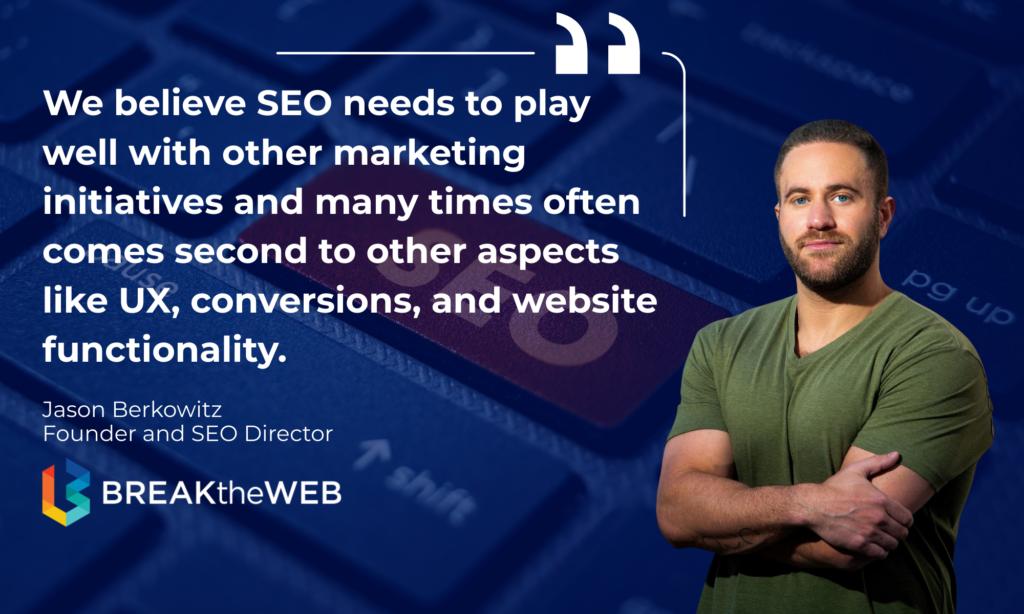
As Jason Berkowitz puts it, SEO often comes second to factors like UX, conversions, and website functionality, because traffic only matters if the experience converts.
Shopify’s own reporting reinforces this connection between experience and revenue, highlighting momentum in payments and checkout (including Shop Pay growth). In other words: if your store isn’t fast and frictionless where it counts such as collections, product pages, and checkout, all SEO wins can be capped by the very experience customers encounter after they click.
Structured data that’s correct, complete, and profit-aligned
Most Shopify stores have some schema. Specialized Shopify SEO makes sure it’s:
- accurate for price/availability/variants
- aligned to product feed reality (Merchant Center, free listings, Shopping)
- extended to category FAQs and buying guides (where appropriate)
- not broken by theme edits or apps
This increases eligibility for richer results and improves how products are understood across search surfaces.
International SEO for Shopify Markets / multi-region growth
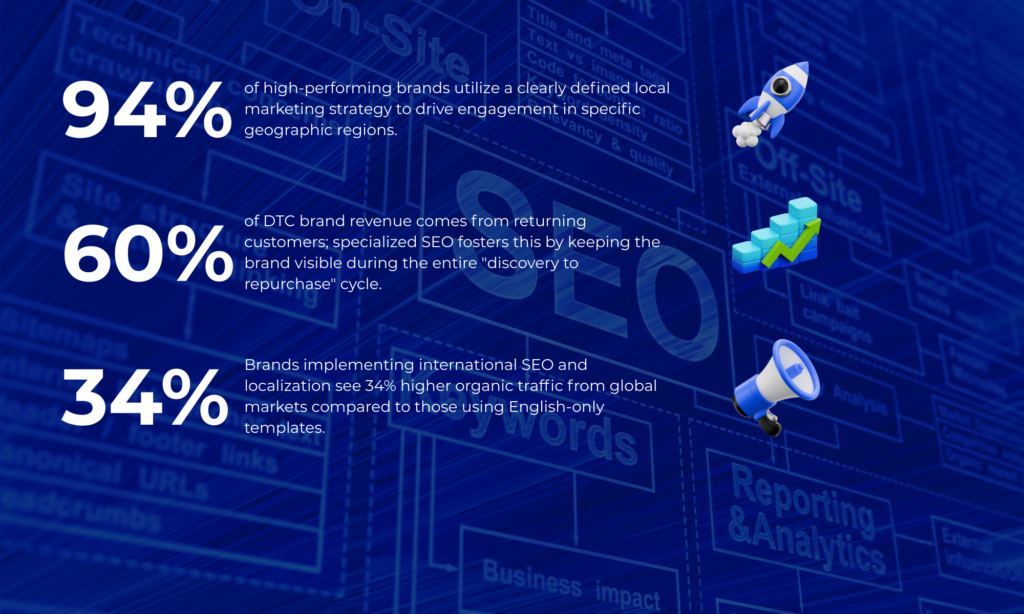
Many DTC brands expand beyond one country faster than they expect. Shopify supports global selling models, but SEO needs:
- correct URL strategy (subfolders vs subdomains vs separate stores)
- hreflang correctness and canonical discipline
- localized collection intent (not just currency switches)
- region-specific content and internal linking
Shopify also continues to push international selling infrastructure (e.g., tools to sell across many countries from a single store), which makes technical international SEO competence more valuable, not less.
Measurement that ties SEO to profit (not just traffic)
DTC SEO should report in a way finance and founders care about:
- organic revenue by collection and product type
- non-brand vs brand mix
- contribution margin sensitivity (shipping, bundles, AOV)
- SEO-assisted paths (where organic introduces the customer)
This is where “rank tracking + sessions” templates fall short.
The 2026 shift: discovery is expanding beyond classic search
 Product discovery is increasingly multi-surface: organic search, shopping results, social search, and AI-mediated interfaces.
For example, Reuters reported OpenAI rolling out in-chat checkout with partners including Shopify, aiming to onboard over a million Shopify merchants. Whether this becomes a major channel or not, it signals the direction: structured data, clean catalogs, strong brand/product entities, and fast storefronts become even more important because machines (not just users) are interpreting your store.
Specialized Shopify SEO prepares you for that reality by treating your store like a product database and a brand experience.
A practical checklist: are you running “template SEO” or Shopify SEO?
If you’re unsure, these are telltale signs you need a specialized Shopify SEO service:
- Your collections rank inconsistently, but blog traffic grows
- You see lots of indexed parameter URLs in Search Console
- Your best-selling products are invisible in non-brand searches
- Apps have piled up and performance has slipped over time
- Product descriptions are duplicated across variants or collections
- International pages exist, but don’t rank in their target markets
- You “have SEO,” but can’t tie it clearly to revenue outcomes
Why this matters for DTC brands
 DTC brands don’t win by ranking for more keywords. They win by building a store that search engines can crawl efficiently, understand confidently, and trust, while customers can shop quickly and convert easily.
That combination is exactly why Shopify SEO can’t be treated like a generic template.

Ready to Transform Your B2B Marketing Strategy?
Get a comprehensive SEO audit and discover how to drive more qualified leads to your business.
Get a Free SEO Audit