Something shifted in how businesses evaluate marketing agencies over the past two years. The conversations changed. The questions changed. The decision criteria changed.
In the past, bringing prospective clients on board was relatively easy. All that was needed was for an agency to show customers some work to get things going and tell clients about some of the schemes that the agency intends to apply. Today, prospective clients want to know about an agency’s expertise as it refers to Artificial Intelligence (AI), the agency’s process for automation, how the tools they have read about function in real-world marketing, and how the agency plans to answer their questions that relate to data-driven business strategies. Prospective clients want to know how what they consider data to be the answer applies to their business.
Agencies in the UK and Ireland are facing the same challenge. These clients are not just large enterprises with deep pockets, but also SMEs who are trying to understand the essence of AI in marketing at their own level and discover what real contributions they can make, as opposed to superficial ones.
The Statistics Problem
The AI marketing statistics circulating right now are genuinely striking. By AI, we mean automation, improved processes, and positive ROI in terms of time and effort. These are high-level indicators. But what’s left in the gray and white are overrated numbers that are considered the “new marketing bible” due to their lack of clarity. These statistics lack quality clarity and provide virtually no answers to the questions they raise.
This creates problems on both sides. Companies often fail to see whether agencies are actually delivering measurable results using AI or if they are simply throwing out buzzwords. For agencies, defining the parameters of what AI can actually do and what is simply a fantasy marketing narrative is a difficult task.
The most productive conversations happen when both parties understand that marketing AI is not a one-size-fits-all purchase. It’s a collection of different capabilities, whether it’s content, automation, analytics, personalization support. Depending on the case, not all of these will be relevant.
The Regional Factor
AI tools have caught on differently depending on where you are in the world. For many businesses, this factor often determines how they search for and select agencies to partner with. London agencies operate in a market where AI terminology is everywhere, making differentiation difficult. Regional markets often have clearer distinctions between agencies with genuine AI capabilities and those without.
Businesses searching for SEO agencies in Dublin and other regional cities face different selection dynamics. The market is smaller. Word travels faster. Agencies can’t coast on marketing terminology as easily when clients compare notes. Performance has to back up the claims.
This regional accountability sometimes produces better outcomes than the more anonymous London market. The Dublin-based agency strives for perfection on a small scale when it comes to Artificial Intelligence (AI) is most likely to deliver the most value. An agency should be able to articulate what they should be able to deliver to a client as opposed to a list of what they can do with the available AI tools.
An agency that delivers on its promises is the one that will build lasting relationships and generate referrals with little need to market their services.
This is also the case in other regional hubs, whether they are Belfast, Manchester or Edinburgh. The small pond effect is both an opportunity and a challenge. Less competition, more visibility for capable agencies, but also more scrutiny and a quick feedback loop when they get it wrong.
What Clients Actually Need to Know
The disconnect between AI marketing hype and practical reality creates space for clearer communication. Businesses evaluating agencies benefit from understanding several things that don’t typically appear in marketing materials.
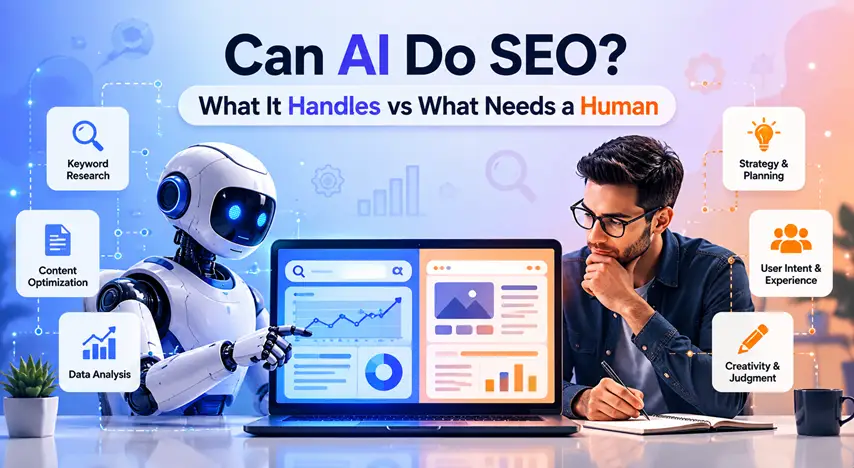
AI has supportive functions, not substitute functions. The best agencies use AI to support humans in their work, not in replacing them. Tools are irrelevant if not combined with effective implementation.
Implementation matters more than tools. Any agency can subscribe to AI tools. The difference lies in how those tools integrate into workflows that produce client results. Two agencies with identical tool stacks can produce dramatically different outcomes based on implementation quality.
Results take time to manifest.Regardless of the performance offered by AI tools, results from marketing efforts will take months, not days. An agency that claims to deliver real, immediate results from AI is either misrepresenting AI’s potential or setting itself up to fail to meet expectations.
Trust is built when an agency sets realistic suppositions and is clear on what is and what is not manageable. In a field where characteristics are highly promising, the agency that understood its own limitations and prioritized the setting of achievable goals showed the clients extraordinary levels of maturity.
The Evaluation Framework
Businesses choosing agencies in the AI era benefit from asking different questions than they might have asked three years ago.
What AI tools do you actually use, and for what purposes? This is the type of question that distinguishes agencies that have authentic use of AI from those that are just using it for their marketing.
How has AI changed your delivery process in the past year? This reveals whether AI adoption is recent marketing positioning or genuine operational evolution. Agencies with real AI integration can describe specific process changes.
What results improved because of AI capabilities versus what results come from fundamental marketing quality? This distinguishes AI contribution from baseline competence. Good marketing agencies produced good results before AI tools existed. AI should not eliminate the underlying capability.
Can you explain the ways AI has impacted your business in tangible and measurable ways? I’m not talking about AI definitions, and I’m asking for AI in this particular instance and thus for specific ways in which AI has outperformed without alternatives. There are real examples of agencies that are capable with real AI.
The Trust Signals
Beyond AI-specific questions, traditional evaluation criteria still matter. Perhaps more than ever, because AI marketing hype makes distinguishing genuine capability from marketing positioning more difficult.
Case studies with measurable outcomes remain valuable, regardless of whether AI contributed. The agency that can demonstrate consistent results across client types provides more confidence than one relying primarily on AI messaging.
Client references who can speak to working relationships matter. AI tools will never replace basic human communication, real responsiveness, and real collaborative problem-solving. There will never be an agency that does not listen to customers and effectively delivers what clients are looking for, even with the most effective tools at their disposal.
Stability and longevity are indicators that an agency is truly shaping its work. Agencies that have embraced changes in the market are better equipped to handle the AI-related transition than agencies that are driven by current trends.
The Regional Advantage Revisited
Regional agencies often possess advantages that get overlooked in conversations dominated by London perspectives. These advantages become more relevant as AI tools reduce some traditional geographic barriers.
Local market understanding translates into strategic advantages. The Dublin agency that understands Irish business culture, regulatory environment, and competitive dynamics provides context that distant agencies lack. The Belfast agency with deep Northern Ireland market knowledge offers insights that pure AI analysis cannot replicate.
Relationship depth develops differently in smaller markets. The agency that’s been serving regional businesses for years has accumulated understanding that recent market entrants don’t possess. This institutional knowledge informs strategy in ways that tools cannot substitute.
Cost structures often favour regional operations. Lower overhead enables more competitive pricing or more generous service allocation at equivalent pricing. Businesses can often access senior talent at regional agencies for what they’d pay for junior staff at London agencies.
Accountability operates at a more personal level. The agency owner known within regional business communities faces different incentive structures than anonymous competitors. Reputation matters more when it’s directly connected to real relationships.
Top Link Building Agencies in 2026
Data Visualization Techniques to Create the Right Visuals
Top SEO Tools for Agencies: How to Make the Right Choice
The Future of Work: How AI Will Reshape the Business Landscape
Making the Decision
For businesses currently evaluating agency partners, the AI era hasn’t fundamentally changed what makes partnerships successful. It has added new dimensions to evaluation without eliminating the importance of traditional factors.
Start with business objectives, not technology interests. The question isn’t “do we need AI marketing” but “what business results do we need, and how can the right partner help achieve them.” AI functionalities must be directed towards objectives.
Look at the people, not the capabilities.
Evaluate the people, not just the capabilities. You’ll be working with specific individuals, not with tool stacks or capability statements. The quality of those relationships determines outcomes regardless of what technologies support them.
Look for evidence of adaptability. The AI landscape changes rapidly. Partners who’ve demonstrated ability to evolve their approaches as circumstances change provide more confidence than those positioned around current trends.
Consider the long game. Marketing partnerships that produce results typically extend over years, not months. The partner selection that makes sense for immediate needs might differ from the selection that makes sense for sustained growth.
The Honest Reality
AI is changing marketing. That’s not hype — it’s observable reality. Marketing in particular is changing in many practical ways that are different from the revolutionary ways that are talked about in the mainstream.
AI is changing the pace of content creation, but the strategic part of content creation is still an AI-human comb job that requires addressing the audience, positioning competitively, and business objectives.
Analysis capabilities have expanded, but analysis without action produces nothing. The agency that turns insights into implementation matters more than the one with the most impressive analytical tools.
Automation enables efficiency gains, but automation of poor processes just produces poor outcomes faster. The underlying marketing quality still determines results.
The businesses finding the right agency partners in this environment are those approaching AI with appropriate expectations — neither dismissing its relevance nor overstating its impact. They’re asking the right questions, evaluating the right criteria, and making decisions based on evidence rather than excitement.

Ready to Transform Your B2B Marketing Strategy?
Get a comprehensive SEO audit and discover how to drive more qualified leads to your business.
Get a Free SEO Audit